
.png)
For decades, "Plain Old Telephone Service" (POTS) was the quiet backbone of building operations. From elevator phones to fire alarms, copper lines powered critical infrastructure. But those copper wires are reaching their expiration date. As major carriers shift toward fiber and 5G, the old network is being decommissioned, and regulators just took the brakes off. A 2026 FCC ruling removed the process that let customers formally object to copper retirements and gave carriers broad approval to phase out legacy lines. In many cases, you’ll get as little as 90 days’ notice before service ends. Copper is now an active financial and safety risk with a shrinking clock.
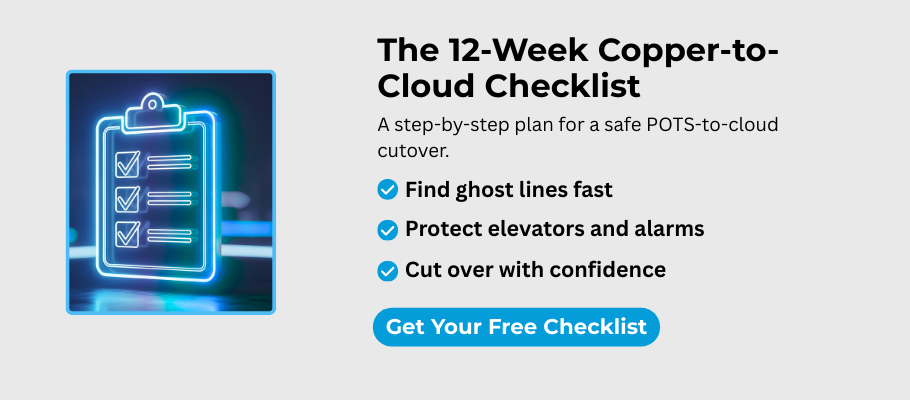
Use our Copper-to-Cloud Roadmap to audit your lines, plan replacements, and avoid service interruptions.
What Changed in 2026
For years, carriers had to clear regulatory hurdles before shutting down copper networks, which gave customers time and a formal way to push back. The FCC’s March 2026 order changed that. Carriers no longer need to go through the old objection process; they can stop selling copper services to new customers, and they can even decline to move an existing line if you relocate. The practical takeaway: a shutdown notice can now arrive with only 90 days of lead time, and there’s no longer a mechanism to delay it.
What Changed in 2026
For years, carriers had to clear regulatory hurdles before shutting down copper networks, which gave customers time and a formal way to push back. The FCC’s March 2026 order changed that. Carriers no longer need to go through the old objection process; they can stop selling copper services to new customers, and they can even decline to move an existing line if you relocate. The practical takeaway: a shutdown notice can now arrive with only 90 days of lead time, and there’s no longer a mechanism to delay it.
The "Invisible" List: What Is Still Riding Your Copper?
Most building managers are surprised by how many essential systems still depend on copper lines. Start by pulling your most recent phone bill and matching each charge to one of these hidden endpoints:
- Elevator Emergency Phones: These must meet ASME A17.1 codes and remain operational 24/7.
- Fire Alarm Control Panels (FACPs): These require instant, interference-free communication with central monitoring stations.
- Security and Burglar Alarms: Many older panels can’t transmit over digital networks without specialized hardware.
- Gate and Entry Systems: Legacy "buzz-in" systems often rely on outdated analog lines that haven’t been reviewed in years.
- Environmental Monitors (SCADA): Pump stations and HVAC systems still use dial-up modems to trigger alerts.
If you haven’t done a line audit lately, there’s a good chance you’re still paying for analog connections that could fail at any time.
AHJ Compliance Checklist: Fire & Elevator Codes
Your Authority Having Jurisdiction (AHJ), typically a fire marshal or building inspector, is the final word on whether your setup meets code. Before making changes, check with them about the following:
- Standby Power: Most AHJs require 24+ hours of battery backup for elevator and fire systems.
- Supervision Intervals: Some require a signal check every hour, others every 24 hours.
- Dual-Path Communication: Many jurisdictions now require a backup path using a second cellular carrier to reduce the chance of failure.
Not every off-the-shelf solution meets these standards. Download the roadmap to understand how to evaluate your options.
Hybrid Connectivity: Combining PIAB and UCaaS
Most buildings need a two-part solution:
- POTS in a Box (PIAB): A hardware unit that safely converts analog signals to digital while meeting fire, elevator, and emergency code standards.
- UCaaS (Unified Communications as a Service): A cloud-based phone system for office users, allowing calls via desk phone, laptop, or mobile app.
This hybrid model eliminates costly copper lines while keeping you connected and compliant.
POTS in a Box: What You Need to Know
A PIAB unit is purpose-built for life-safety systems. It includes:
- 24-hour internal battery backup
- Dual-carrier cellular failover
- Analog-to-digital signal conversion
These features ensure uninterrupted operation of your fire panels and elevator phones during power loss or network outages. PIAB is now considered the gold standard for maintaining NFPA 72 compliance.
UCaaS: The Cloud-Based Communication Engine
For office and remote users, the future of voice is UCaaS. Unlike legacy on-prem phone systems, UCaaS runs in the cloud, offering built-in disaster recovery, mobile access, and flexible device options.
TechRepublic's recent "Top Trends Shaping Enterprise IT Infrastructure" report highlights that resilience must be a "core design principle," not just a backup plan. By moving your phone system out of the physical server room and into the cloud, you build that resilience directly into your architecture, keeping calls flowing even if the building loses power.
Avoiding the Legacy Tax
Carriers are raising prices on POTS lines to push customers toward modern alternatives, and the new FCC rules give them little reason to hold back. In some regions, costs have jumped over 200%. Lines are also being "grandfathered," which means you may be able to keep what you have for now, but you can’t order new lines or move existing ones
Staying on copper means:
- Paying more each month
- Dealing with more frequent service failures
- Falling behind on safety compliance
The Copper Sunset isn’t just a technology sunset. It’s a budget cliff.
Your Next Step: Plan the Cutover
A 90-day notice gives you roughly 12 weeks. That’s exactly how the roadmap is built. It provides a detailed timeline to complete your migration in 12 weeks or less:
- Audit every analog line and identify life-safety endpoints.
- Validate local code requirements with your AHJ.
- Select a PIAB solution and UCaaS provider.
- Coordinate installation with your vendor and carrier.
- Test and document compliance.
-1.png?width=910&height=400&name=Lead%20Magnet%20Graphics%20(1)-1.png)


.webp)